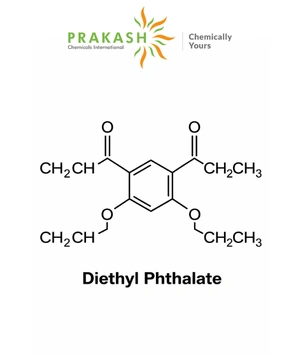




Di Ethyl Phthalate
- HS Code: 29173400
- CAS NO. : 84-66-2

- General Description
- Technical Specification
- Applications
- Compliance and Certifications
- Packaging Details
- Storage and Handling
General Description
Diethyl Phthalate (DEP) is a versatile, high-purity organic ester widely used across industrial, pharmaceutical, and personal care applications. With its excellent solvency, low volatility, and stability, DEP serves as an effective plasticizer for plastics, a carrier solvent in fragrances, and a formulation aid in cosmetics and pharmaceuticals. Its nearly odorless profile and compatibility with a wide range of materials make it ideal for enhancing flexibility, solubility, and performance in formulations. Manufactured to stringent quality standards, DEP ensures consistent performance, safety, and reliability for diverse commercial and industrial uses.
Technical Specification
• Appearance Colorless to pale yellow liquid
• Purity (GC) ≥ 99%
• Specific Gravity (at 25°C) 1.118 – 1.123
• Refractive Index (at 25°C) 1.495 – 1.498
• Boiling Point 298–300°C
• Acid Value ≤ 0.5 mg KOH/g
• Moisture Content ≤ 0.1%
• Solubility Insoluble in water, miscible with alcohol, ether, and oils”
Applications
• Plasticizer: Enhances flexibility in PVC, plastics, and coatings and spectacle frames.
• Fragrance Industry: Solvent and carrier for essential oils and aromatic compounds.
• Cosmetics & Personal Care: Used in perfumes, hair sprays, and nail polish formulations.
• Pharmaceuticals: Plasticizer and solvent in tablets, capsules, and liquid formulations.
• Industrial Uses: Component in adhesives, inks, resins, and coatings.
Compliance and Certifications
• REACH
• Food Grade
• KOSHER
• HALAL
• GMP
Packaging Details
• 225 kg HDPE Drums
• 1125 kg IBC
• ISO Tanks
Storage and Handling
• Store in a cool, dry, well-ventilated area, away from heat and flames.
• Keep containers tightly closed and away from strong oxidizers.
• Recommended containers: HDPE, glass, or steel.
• Ideal storage temperature: 15–30°C.
• Avoid inhalation and prolonged skin contact; use PPE (gloves, goggles, protective clothing).
• Ensure proper ventilation during handling.
• In case of spills: absorb with inert material and dispose according to regulations.